
A Black History Month Special
As I’m regain my footing on the blogging scene, I wanted to share some thoughts to commemorate Black History Month before it slips away. I’ve been somewhat distracted by activity happening in our nation’s Capitol. The state, local, and international political scene is also abuzz with political activity. For me, as an expressive artist, I need to focus and concentrate my creative energies in order to produce art. In this hypercharged political climate, focus has been challenging to achieve. Everything seems so overwhelming to process.
But then as I unplug myself from all media, including social media, and reflect on my thoughts during Black History Month let my thoughts settle down, then I realize that all these micro- and macro-activities, the protests, the polling, the debates, the electioneering, the dissent that I find overwhelming is maybe an indicator of a healthy democracy. All this rhetoric and activity and activist action is to promote the pursuits of life, liberty, and the progress towards more equal human rights.
Add in rebellion and insurrection, and you can imagine some of these same activities occuring four centuries ago when we grappled with the same type of thorny questions pertaining to the differents rights groups should have in our democary. Then, found hundred years ago, it was more about resolving the disjointed vision of establishing the bedrock of a healthy democracy through the labor of enslaved peoples, most notably on the backs of Africans and their African-American descendants..
This disonant note still remains an unresolved shrill in the political discourse of American democracy because, even in a post-Obama era, our political leaders have yet held open and frank discussions on race, again, perhaps the most notable being the African-American descedents of the enslaved Africans who were trucked across the Atlantic during the slave trade.
Of course, the early historical events of American slavery sets the stage for the subsequent struggles of African-Americans, including the insidious system of the racially-descriminatory institution of Jim Crow, which imposed laws relegating African-Americans to second class citizenry. The triumps and sacrifices of African-Americans fighting for their civil rights during the post-slavery period in this country represents the core of what Black History Month celebrates.
As a creative in several artistic disciplines, I am proud African-American writers, visual artists, musical artists, dance artists, and theatrical and cinematic artists played a critical role in expressing the forms, performances, and messages that supported this progress for human rights. Many of these artistic forms and performances as well as my own experiences and lifelong study of African-American and African history influence my own artistic work.
During Black History Month, I’d like to share three paintings of my Black History Painting Collection associated with the Trans-Atlantic Slave Trade, with historical references (mostly videos, pictures, definitions, and some personal references). Let me warn you, my visitors, one of my paintings, as well as some of the historical references, may be graphic and offensive in nature. Consequently, I section off the third painting of this series, The N* Word. So, in honor of Black History Month, here are three of my artworks influenced by the African-American civil rights struggles, past and present, in this post-Obama era.
My three (3) paintings and the order I discuss them:
- Painting 1 - Madonna Carrying Son
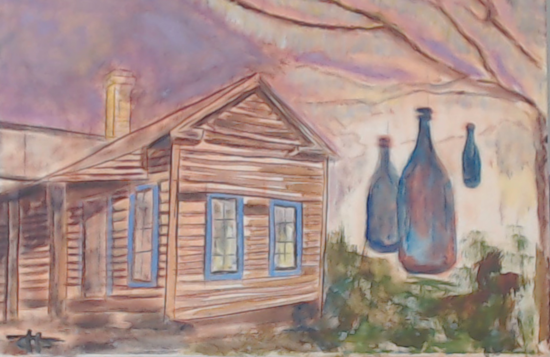
- Painting 2 - Haints of Hilton Head
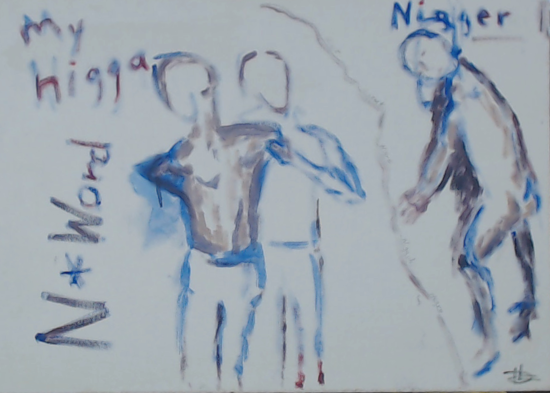
- Painting 3 - N* Word [Warning: Disturbing Image]
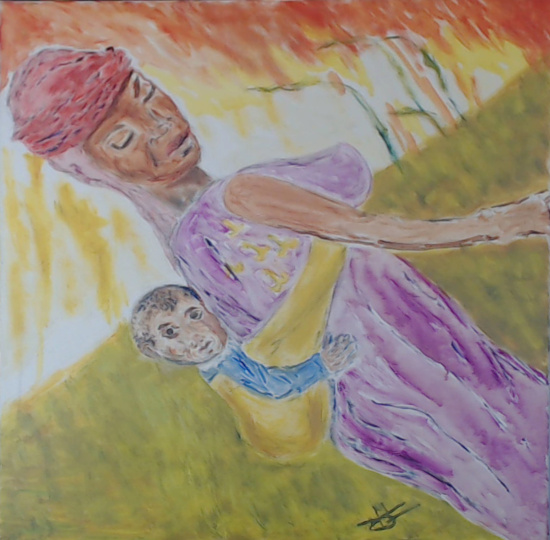


Madonna Carrying Son
As an African-American artist exploring forms influenced by the enslavement of Africans and African-Americans and their institutions and cultrual practices, the influences of an artwork may not be always readily apparent. Such is with my painting entitled Madonna Carrying Son.”
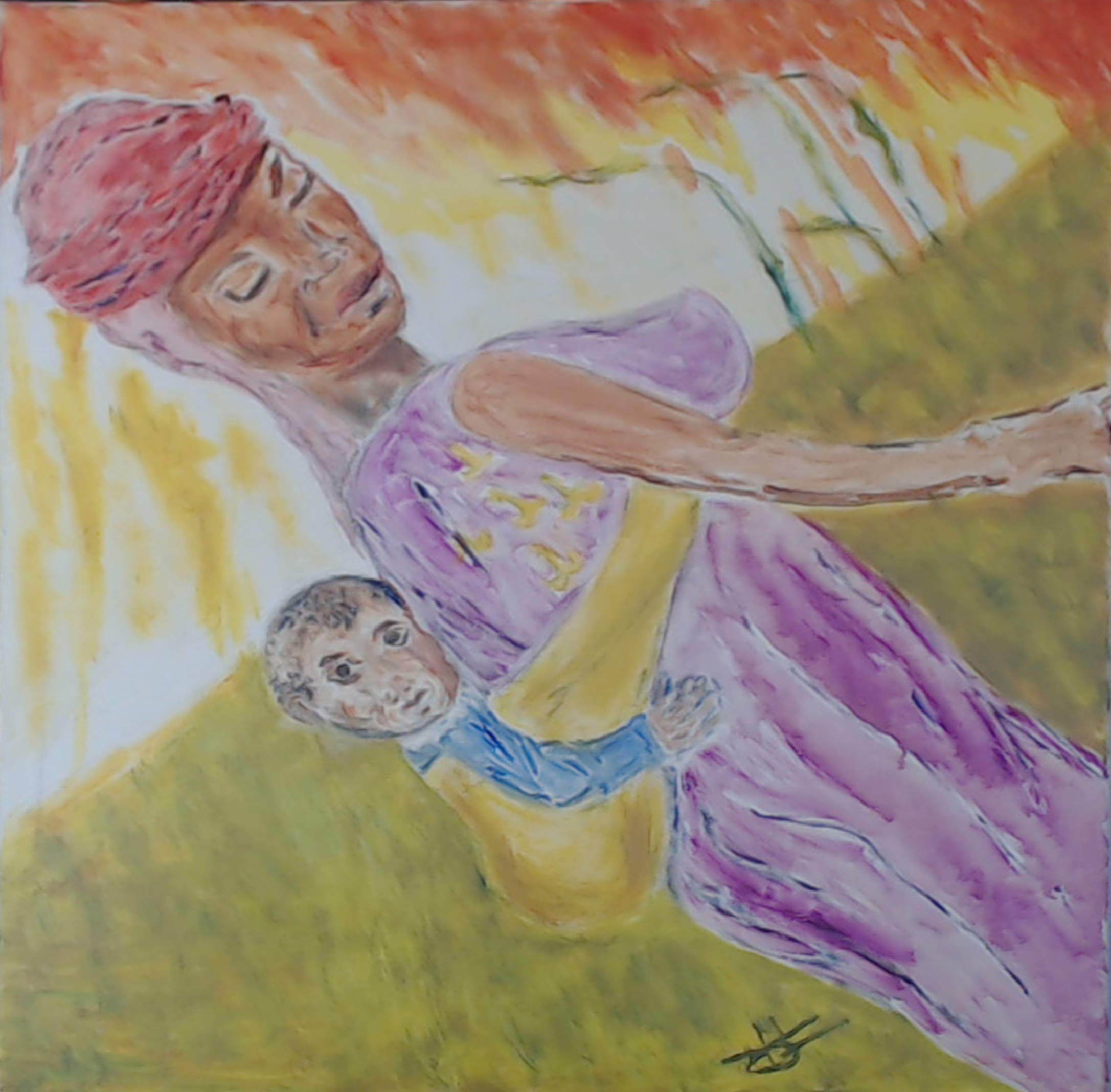

Madonna Carrying Son depicts a mother carries her infant son in a carrier. The two human forms of the painting are obviously of African descent. Noting the mother’s purple dress, red headwrap, as well as her queenly bearing, the woman appears to be someone of status. She’s Madonna, a human descendant of the archetypal earth mother from which sprang the cradle of civilization. Madonna totes her son, a copper-haired child, in a golden infant carrier.
Characteristics of Madonna remind me of my mother and other strong and confident maternal figures of my life who carried an air of regalness. The infant is modeled on my imagination of how I remember myself as an infant, as I allegedly born with headful of golden-coppery hair, which darkend over time, but still remained coppery long into my teens along my hairline and on my hairy legs and arms.
According to mythology historian Joseph Campell, motifs of Madonna, as the earth mother archetype, is represented in many cultures across the globe. This motif of the earth mother with her son begins with Egyptian mythology of Isis sitting on the throne nursing her son Horus, which gave rise to Roman-Catholic traditions of celebrating the virgin birth as introduced in the Christian gospel of Luke. As Luke was Greek, he was familiar with the Helenistic Greco-motifs of the virgin birth as expressed through the early myths of Leda and the Swan or by Persepone and the Serpent (see video references).
So, in Madonna Carrying Son, what are the ancestral origins of my Madonna? She is a classic black Madonna who represents the fertility earth mother Isis. My Madonna has an ample bosom which emphasizes her role as a nurturer. Her royal purple dress offers a clue to this puzzle. Examining the bodice of this mother’s dress, you will note against the field of purple fabric is a pattern of yellow fleur de lis. Though regal, this woman was perhaps an enslaved person.
The French-inspired fabric of her dress suggests this woman of African descent might have family origins in a French colony, somewhere in west Africa, perhaps Sierra Leone, or one of the countries of the French Ivor Coast or perhaps even as far south as Angola. At some point during the history of the slave trade, the British re-established a base of operations at Bunce Island.
Perhaps, Madonna might have been kidnapped from her African village or city, or from a powerful African kingdom by conquering warring African factions and branded as chattel at Bunce Island or another colonial slave processing center, and then trafficked to one of the Caribbean slave centers. Or she might have been destined for the French, or more likely, British colonies of North or South America.
Ironically, if she were captive after American independence, then she might have ended up on the eastern seaboard at one of the slave trading ports of the United States of America, Charleston, South Carolina, being among the busiest. Forced into a new homeland with a climate similar to West Africa, her American slave masters would have valued her expertise. Despite this status, Madonna still would be worried about her son being sold off as chattel at a certain age.


Painting 2 – Haints of Hilton Head
Enslaved Africans and African-Americans trafficked through the port of Savanah, Georgia, would have been sold to regional plantations to cultivated cotton and sugarcane, two major cash crops of the region. However, Madonna, a skilled crop cultivator of a variety types of rice, perhaps the most specialized cash crop of the area, would have sold at a premium to an area plantation of nothern Florida, Georgia, South Carolina, perhaps one of the Sea Islands, for example, Hilton Head Island.
Haints of Hilton Head shows the type of housing in which Madonna and her son might have dwelled, as part of a Gullah community. Peoples of west African descent who worked the coastal rice plantations were called Gullah, sometimes the Geechee, or the Gullah Geechee, as often used today to refer to the settlers descended from these enslaved peoples and formally recognized as the Gullah/Geechee Nation. Though Gullah and Geechee as terms appear to be used interchangeably in many references, dictionaries too often disagree on precise definitions of these terms.
Before I discuss this painting any further, let’s reference the American Heritage (5th edition, 2019) for a baseline comprehensive definition. In this context, Gullah is: 1) One of a group of people of African ancestry inhabiting the Sea Islands and coastal areas of South Carolina, Georgia, and northern Florida; 2) The creolized language of the Gullahs, based on English but including vocabulary elements and grammatical features from several African languages and spoken in isolated communities from Georgetown in eastern South Carolina to northern Florida.
American Heritage Dictionary suggests Gullah might be an alteration of Angola or from Gola, a people of Sierra Leone and Liberia. Merriam-Webster suggests the term was used to refer to these peoples as early as 1822, nearly four decades before the signing of the Emancipation Proclamation. Other souces cite this word, in variant forms, being used as early as the 1700s. The Spanish established a number of missions on the islands in the 1500s and 1600s.
Geechee is defined by American Heritage Dictionary (2019) as a noun pertaining to Coastal South Carolina and Georgia. 1) a. The Gullah creole; b. A speaker of Gullah; 2) Offensive-Used as a disparaging term for a person who speaks a nonstandard local dialect, as in Savannah, Georgia, or Charleston, South Carolina. American Heritage Dictionary suggests the word derives from the Ogeeche River, around which some Gullah communities live or perhaps from Kissi, an ethnic self-designation of the Kissi or, more probably, a reference to Atlantic Niger-Congo language of Guinea, Liberia, and Sierra Leone.
Although nowadays acknowledged as the Gullah/Geechee Nation, by federal commission, its historical region would have concentrated enslaved populations around coastal Georgia and South Carolina, including the chain of 80 or so barrier and tidal off their coast. However, perhaps due to migration patterns, the Gullah/Geechee Cultural Heritage Corridor has been redefined to extend as far south as Jacksonville FL up the coast to Wilmington, NC.
An alternate origin for the name Gullah, some historians suggest, derives from a period between the 1500s and 1600s when the Spanish, in the course of establishing missions on the islands off South Carolina and Georgia, encountered a Native American tribe called Guale. Consequently, Guale became one of four primary Spanish mission provinces along with Timucua, Mocama, and Apalachee. I’d like to explore this possible Native American connection in the future.
Isolated places like Hilton Head Island were crucial in enabling their Gullah/Geechee inhabitants to develop a rich cultural identity of melding influences of western Africa, colonial America and Europe, Native Americans and their own distinctly African-American ingenuity. Many of these distinct expressions are readily recognized through Gullah/Geechee language, cuisine, music, dance, and art.
The weather-worn dwelling featured in Haints of Hilton Head is primarily constructed of wooden clapboard and corrugated sheet metal roofing. These types of dwellings familiar to the region were common for slave quarters. An area tradition by Gullah dwellers required the hanging of cobalt blue bottles from nearby trees as a protection against evil spirits or haints. Some historians believed this practice correlated with similar purification rituals used in west Africa.
The blue bottles entrapped or repelled roaming evil spirits who would harm property residents. Moaning and whistling were said to be trapped haints crying out. Some practicioners believed these spirits became forever trapped in the bottles; other practioners believed the haints dissipated as the morning light streamed through the blue glass. The blue bottles also encouraged visitations by beneficial spirits bringing blessing with them.
A friend of mine, upon seeing Haints of Hilton Head, explained his family still owned property in South Caroline featuring these historical wooden clapboard houses with corrugated steel roofs. Today there are initiatives aimed at preserving these dwellings and the associated Gullah/Geechee culture and traditions. However, much of this culture is quickly disappearing. For example, Hilton Head Island and other of the Sea Islands are becoming surging resort areas.
Here are some of some additional information about national efforts to preserve the history of the Gullah Geechee Nation and its cultrual heritage. Some of these preservation efforts also include reconciliation efforts to reacquaint African-American Gullah with their ancestral homeland in west Africa. At the time of this writing, another fledgling initiative aims to restore Bunce Island, the colonial administrative trading post responsible for processing Africans slaves trafficked to the Caribbean and the Americas.

Painting 3 – The N* Word
Disturbing/Offensive Content Warning
Please be warned that the painting in the following section of this post contains a lynching image and a brief discussion of the N-word. Although the image is not explicitly graphic and the discussion of the N-word is brief, some viewers may still find such material disturbing and offensive. The reference materials of this section may also be difficult to review. If this is the case, you can scroll to the next warning frame and continue reading.

The third and last painting I want to discuss is entitled N* Word. This painting makes me sad and angry, especially since the ultra-minimal style of painting fully exposes the central forms of the composition. Employing such a minimal style and the limited color palette is akin to producing a stripped down musical track where the featured vocal performance receives the attention. This technique enabled me to express the essence of my rage without creating a detailed, sensationalized image, which would have romanticized the subject.
When I was 11 or 12 years old, my mother introduced me to the subject of Black History by gifting me an extraordinary history book. As a precocious child, I was eager to be awakened to a history that is often shielded, the history of how African-American were historically treated. Some of the photographs featured documents supporting different aspects of commercial slavery: a poster announcing the auction of slaves, a bill of sale of a particular slave, and pictures of slaves on the auction block. It thoughtfully chronicled this and other shocking historical aspects about the cruel treatment of African-Americans, which many history books whitewash over.
Another chapter of the book that fascinated, as it chilled me to the bone, were a series of photographs depicting one or several black men dangling from trees by their necks. Other pictures featured black women and black children. Perhaps the photograph I found most disturbing of the series was one in which a crowd of white people stood around a lynched and burnt corpse smiling and laughing while an adolescent girl unemotionally looked on.
Of all the photographs, that one chilled me and challenged me. The imagery of these photographs deeply affected me; I wondered how this white girl standing in the midst of an actual lynching felt. Was she emotionally traumatized by this sight. She didn’t appear to. Did she ever develop remorseful feelings about this event? I figured the hearts of the white racist adult onlookers were probably immuned to the suffering of these African-Americans who tortured corpse dangled above them like strange fruit, as blues singer Billie Holiday conveyed hauntingly in rendition of Strange Fruit. I know this white girl is probably long dead and buried, but I still wonder about her humanity.
So when I approached painting this subject a few years ago, I had a lot of unreconciled emotions. Anger and sadness were the most quckly identified ones. But there were other emotions, I knew, brewing underneath, emotions I couldn’t voice. So I decided to purge these emotions on canvas. Painting, like writing is therapeutic for me. So, when I don’t know what I’m feeling or cannot adequately express those emotions with words, I rely on artistic outlets to express myself.
So, those are the creative impulse which led me to create this painting. Although the painting is spare by choice, the choices I made to execute the painting were very deliberate. For example, the use of canvas board instead of a stretched canvas gave the finished painting a textured, hard-edge appearance. Another choice to de-emphasize the sensationalism of the N* Word included painting the main two main images of the composition against an empty background. This decision removed background details that could distract the viewer.
Also, I limited my color palette to a handful colors, all muted. Moreover, I restricted the amount of paint I allowed myself to lay down on the canvas. The stark whiteness of the canvas was a dominant feature of the composition. Lastly, I didn’t prepare preliminary sketches or a value study or color studies, as I usually do. I didn’t even lay down a pencil sketch . Instead, I spontaneously sketched each of the figures on the canvas directly with paintbrush, as I didn’t want to overthink the composition. The objective was to allow my emotions about the subject guide me through the composition. By being authetically in the moment, the final outcome is spontaneous, emotional, and intenful.
The left side of the canvas depicts two African-Americans greeting one another socially with my nigga! as in, “Hey, wasup, my nigga!” In this case, the n-word is spelled n-i-g-g-a. The right side image of the canvas depicts the image of an African-American male hanging from his neck with the word n-i-g-g-e-r scrawled above his head. None of this imagery is elaborately illustrated or graphic beyond a spontaneous-paintbrush sketch.
The strong imagery of the painting is an unapologetic reminder the N* word, as an instrument of verbal violence, served as a warning to remind African-Americans of their place as a second-class citizen under the discriminatory system of laws known as Jim Crow. The fact Jim Crow is affiliated with a derogatory representation designed to demean African-Americans made this word more painful.
If African-Americans became emboldened and asserted their rights, then N* word epithets were hurled at them, which quickly escalated into beatings, finally culminating into being lynched, which, in the eyes of racist whites, disposed of immediate threats and preserved the system. The hanging and defiled body served as a darker warning African-Americans of the consequences of stepping out of line.
Can the imagery of the young African-Americans on the left side of the composition affectionately greeting each other as my nigga ever reappropriate the nigger-version of the word. After all, if the Sierra Leone connection with their reoriented version of the N-word creates a tension with the derogatory use of the N-word which sometimes lead to tortured killings.
So from where might the N-word originate? And, like the Gullah/Geechee Nation, can the N-word be culturally reappropriated like some African-American attempt to do with the nigga-variant of the N-word? If so, would it be worth the effort? Should restoration and re-appropriation of culturally significant terms be a priority?
“By the 1480s, Portuguese ships were already transporting Africans for use as slaves on the sugar plantations in the Cape Verde and Madeira islands in the eastern Atlantic. Spanish conquistadors took African slaves to the Caribbean after 1502, but Portuguese merchants continued to dominate the transatlantic slave trade for another century and a half, operating from their bases in the Congo-Angola area along the west coast of Africa. The Dutch became the foremost slave traders during parts of the 1600s, and in the following century English and French merchants controlled about half of the transatlantic slave trade, taking a large percentage of their human cargo from the region of West Africa between the Sénégal and Niger rivers.”
https://www.britannica.com/topic/transatlantic-slave-trade
As the main river of western Africa, the Niger River is over 2500 miles (4180 km) long. Crescent in shape, it flows through Guinea, Mali, Niger, on the border with Benin, and then through Nigeria.
According to Wikipedia (Niger River), the Niger has different names in the different languages of the region. If you look carefully, the Tuareg language contains an early etymology of the word Niger:
- Tuareg: Egerew n-Igerewen “river of rivers”
- Manding: Jeliba or Joliba “great river”
- Igbo: Orimiri or Orimili “great water”
- Songhay: Isa “the river”
- Zarma: Isa Beeri “great river”
- Hausa: Kwara
- Yoruba: Oya
- Fula: Maayo Jaaliba
If you accept the close association of the River Niger as a transportation facilitator, it’s quite possible that these captured Africans being sold and transported by the great River Niger might not have been referred to as peoples of the Niger as we might referred to other peoples as peoples of the Americas.
Of course, for short, in the above example, peoples of the Americas, might be called Americans for short, regardless of which of the Americas. In this same way, peoples of the Niger might be known as Nigers. Nigers could have been easily corrupted as Niggers. By itself, this corruption may be innocuous a clerical error, had it not been weighted by the connotations of violence, bigotry, and racial hatred.
Does this mean that repeated use of the nigga-variant by African-Americans can restore the word to a baggage-free word? Not necessarily. Although the Gullah/Geechee Nation decided to reappropriate the word geechee, which, in some cases may still retain derogatory connotations, the Gullah/Geechee nation believed it important to regain a part of their cultural identity.
The N-word has such a long history as a derogatory term and is a word which is much more familiar to the average person than geechee, that to reappropriate the word would reguire a greater magnitude of effort. The River Niger is such a vital river to the economic prosperity of western Africa that Niger and Nigeria viewed it as an honor to name their respective peoples to celebrate the river. These peoples will carry on the name, and, in my opionion, no reappropriate necessary.
Then, if African-American reappropriation of the word isn’t necessary or even desireable, should we ban the variant-nigga spelling to disallow anyone from using the word? I’ve heard this recommendation, but, again, is this even possible or desirable. If using this word were akin to yelling fire in a movie theater, an act that would endanger people, then there would be no debate. The law is clear in this regard.
However, in a country founded on the principles of free speech, denying anyone use of any word amounts to censorship. Civil rights would have floundered if people were censored. Art would have floundered also. Besides, who do we select to be the arbiter of what is censored and what is not? Whose sensibilities and judgment should we trust in this regard?
Although there exist no quick-fix resolution to this matter, we need to respect every individuals right to free speech, no matter how much we find such speech reprehensible. This doesn’t mean we like the actual speech itself. It simply means that if we want our right to free speech protect, we need to protect the right of others, even someone’s who rhetoric we dislike. How much more reprehensible speech exists in this coutry, than comrades greeting one another as my nigga.
I’m more concered with speech that becomes incendiary and incites others to commit violence against me and others. This type of speech isn’t protected by our Constitution, as it shouldn’t be. This is the speech that used the N-word to incite acts of beatings and lynchings so prevalent during slavery and through our long history under Jim Crow. That’s the type of rhethoric we need to be vigilant against.
Here are some additional references which demonstrate the history of lynching in this country and how it has affected African-American life, politics, and culture.
End of Disturbing Content Warning
This marks the end of the previous section.
Okay, so you have it. This post featured three of my paintings and how the forms expressing these compositions have been influenced by my experiences and form I have absorbed second hand through the study of the history of others. Some of these forms affirm, some disturb and traumatize. Some of these forms concern race, culture, and identity. Even shared forms of artistry. No matter the experience, no matter how I choose to frame them, they all, more or less, shape my psyche as an African American, and, equally as a creative and expressive artist.
Maybe then the forms that reflect in my future art won’t be the echoes of deep bigotry, historical racism, pain, and psychic trauma inflicted by being a peoples wrenched from the bosom of an ancestral homeland. Maybe one day Black History Month will represent a coming together of all Americans to celebrate and commemorate our history as Americans.
As an educator, author, and creative artist, I feel a deep and palpable connection to the past and to the future. Some of the forms I express uplift my spirit and the spirit of others; while others haunt. But as an artist who acknowledges my best work is produced when I give free rein to my creative impulses, which I’m never fully in control anyway.
Many of the artistic forms I create prompt me how to most effectively express them. Whether our artform is music, spoken word, dramatic arts or dance arts, whether we express through visual forms on canvas, or through bodily movement through space, we have to find what inspire us. As artists, we each have a role to play in recording and commemorating our history. For many of the vital and progressive events of Black History came at the price of the sacrifice of others.
https://bkhemphill-art.myshopify.com/admin/themes/43689246801/editor#/collections/womens-t-shirts/products/short-sleeve-t-shirt
You must be logged in to post a comment.